SodaSlim Official Website › Blog › How Much Caffeine
How Much Caffeine Is In A Metabolism Capsule?
Caffeine is the best-evidenced ingredient in this entire category and the only one whose effect depends directly on how much of it there is. It is also the figure most of these labels leave out, and a capsule you cannot count is a capsule you cannot fit into a normal day.

- Caffeine is dose-dependent. Fifty milligrams is a cup of tea and two hundred is a large coffee, and the difference decides whether a night's sleep survives it.
- Three of the five ingredients on this kind of label carry caffeine: the anhydrous row, the green tea extract and the green coffee extract.
- The usual ceiling for a healthy adult is 400 mg a day from every source combined.
- Where no figure is printed, the safe working assumption is that a capsule is worth one strong coffee, and the right move is to remove one from the day.
- It is a phone call to find out. Quote the lot number and ask for milligrams per capsule.
Why caffeine is the number that matters
Most ingredients in a metabolism capsule behave roughly the same way at a hundred milligrams as at fifty. They are either doing something small or nothing at all, and a doubling does not change the character of the experience.
Caffeine is not like that. It has a clear dose-response curve for alertness, for heart rate, for the rate at which energy is spent and for how long sleep is disrupted. Somebody taking 50 mg and somebody taking 250 mg are having two different days.
That is why a printed milligram figure is the single most useful thing on a label in this category, and why a label without one has left out the part that would have let a reader make a decision. On this bottle the amount is absent, which is the reason this post exists and the reason the ingredients page is built around trial doses instead.
Three sources in one capsule
A common mistake is to read the caffeine row and stop there. On a formula like this one there are three contributors, and only one of them announces itself.
- Caffeine anhydrous. Caffeine with the water removed, which is what makes it practical in a capsule. It is the same molecule as the caffeine in coffee and it is the row that gets named.
- Green tea extract. Concentrated catechins, and unless the label says decaffeinated, caffeine travels with them. The proportion varies enormously between extracts.
- Green coffee bean extract. Unroasted coffee, which is where the chlorogenic acid survives. It is still coffee, and it still carries caffeine.
So a label naming one caffeine row and two caffeinated extracts is delivering more than the named row suggests. Without standardisation figures for the two extracts, there is no way to say how much more.
| Where the caffeine comes from | Typical amount | Is it on a label |
|---|---|---|
| Filter coffee, 240 ml | 95 mg | No. It varies with the roast and the brew |
| Single espresso | 63 mg | No |
| Black tea, 240 ml | 47 mg | No |
| Green tea, 240 ml | 28 mg | No |
| Cola, 355 ml | 34 mg | Yes, on many |
| Energy drink, 250 ml | 80 mg | Yes, and it is required |
| A caffeine tablet | 100 or 200 mg | Yes, always |
| A supplement naming caffeine anhydrous | Anything from 25 to 300 mg | Only if the label prints a panel |
Drink figures are ordinary published averages. The last row is where this category sits.
The bottom row of that table is the honest position for most of this category. A caffeine tablet is required to print its figure because that is the whole product. A multi-ingredient capsule can name caffeine anhydrous and say nothing else, and a great many do.
Working out your own budget
The Health Canada review collects the dose-response evidence for caffeine and puts the usual ceiling for healthy adults at 400 mg a day from all sources. That is not a cliff edge; it is the point above which the unpleasant effects become common rather than unusual.
The useful exercise takes two minutes. Count what an ordinary day already contains, then see what is left.
| A day that contains | Running total | Room left under 400 mg |
|---|---|---|
| One filter coffee | 95 mg | 305 mg |
| Two filter coffees | 190 mg | 210 mg |
| Two coffees and an afternoon tea | 237 mg | 163 mg |
| Three coffees | 285 mg | 115 mg |
| Three coffees and a cola | 319 mg | 81 mg |
| Four coffees | 380 mg | 20 mg |
400 mg a day is the usual ceiling for healthy adults in the Health Canada review cited below. The point of the right-hand column is that a capsule has to fit inside it.
- Count your normal day honestly, including the afternoon one you forget about.
- Subtract from 400 mg. What remains is the budget a capsule has to fit inside.
- If the remainder is under 100 mg, a capsule of unknown strength is a bad idea until you know the figure.
- If the remainder is over 200 mg, there is room for most of what this category sells.
- Either way, remove one caffeinated drink from the day you start the capsule. It is conservative and it costs nothing.
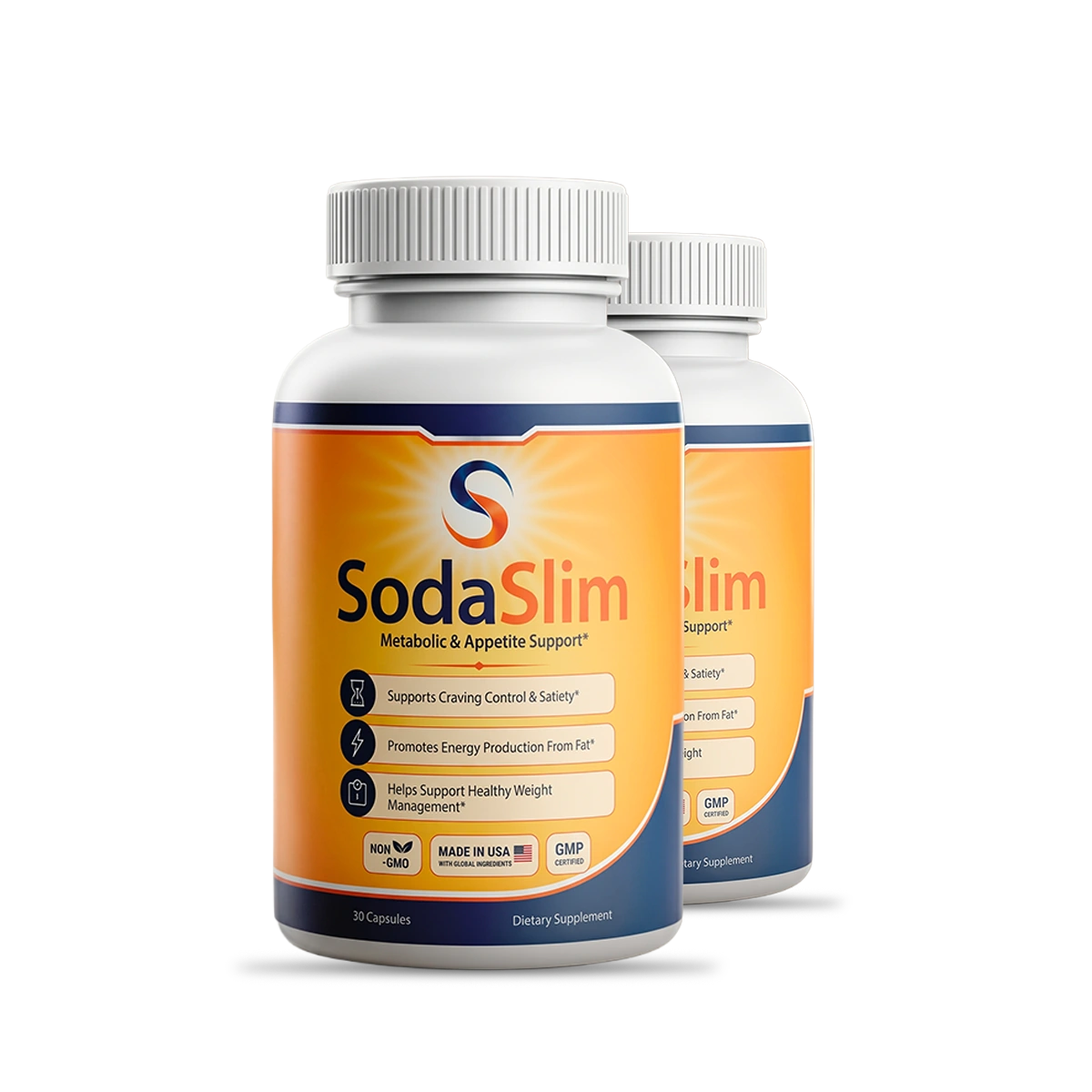
Order SodaSlim on the official website
One capsule each morning, 30 to a bottle, and 60 days from the date of purchase to decide.
Two bottles $158 · six bottles $294 · 60-day money-back guarantee
Order SodaSlim On The Official WebsiteOne capsule a day · 30 per bottle · lot SOD-26/SE-1477
What the evidence says caffeine actually does
The 1989 study is the one worth knowing about. Volunteers were given 100 mg of caffeine and their metabolic rate rose for the following two and a half hours. Repeated through the day, the effect showed up in total daily energy expenditure, in lean and post-obese participants alike.
That is a real, replicated finding and it is more than can be said for most of this category. It is also modest: the effect is measured in tens of kilocalories per dose, and tolerance blunts part of it in people who already take caffeine daily.
The cardiovascular side of the same picture is in a meta-analysis of randomised trials, which found chronic caffeine intake raised systolic blood pressure by a small but measurable amount. Anyone already managing blood pressure should treat that as the reason to raise a new stimulant with their prescriber rather than as a prohibition.
Why tolerance matters to the arithmetic
Part of the alerting effect of caffeine blunts within days in regular consumers. The thermogenic effect is less well characterised but appears to behave similarly.
The practical consequence is counter-intuitive. Somebody who drinks no coffee gets more from a capsule than somebody who drinks four, and also tolerates it less well. The lowest baseline is both the best case for an effect and the worst case for side effects, which is an argument for starting on the smallest pack rather than the cheapest one.
The cost nobody puts on the label
A 2025 randomised crossover trial measured the dose and the timing of caffeine against the sleep that followed, and found both mattered independently. A larger dose costs more sleep, and the same dose later in the day costs more sleep than it does earlier.
A 2015 study went further and showed caffeine shifts the circadian clock itself, not only the feeling of alertness. That is a slower and more persistent effect than the one most people are guarding against.
Caffeine's half-life runs around five hours in most adults, which means a capsule taken at eight in the morning is still a quarter present at eleven at night. A morning instruction on a label is worth following rather than treating as a preference.
Nothing in this category has evidence strong enough to justify losing an hour of sleep a night. Short sleep works against appetite regulation, against activity and against every outcome a metabolism capsule is sold for. If a capsule costs you sleep and moving it earlier does not fix it within a week, stop taking it.
How to get the figure
A missing number on a label is not always a refusal. Sometimes it is a packaging decision nobody revisited. Either way there is one route to it.
- Ring the order desk. On this desk that is +1 (302) 200-3480. Quote the lot printed on the base of the bottle, which on this stock is SOD-26/SE-1477.
- Ask two specific questions. Milligrams of caffeine anhydrous per capsule, and the total catechin content of the green tea extract. Both are one-line answers for a seller who holds a panel.
- Ask whether a certificate of analysis can be shared. The document, not the reference number.
- Write down what comes back. A seller who answers in one call has told you something about how they operate, and so has a seller who cannot.
Whatever the answer, the conservative approach works in the meantime: treat the capsule as one strong coffee, take it before ten in the morning with food, and remove one drink from the day. The how to use page sets that out as a routine, and the side effects page covers what to watch for.
References
- Dulloo AG, Geissler CA, Horton T, et al. Normal caffeine consumption: influence on thermogenesis and daily energy expenditure in lean and postobese human volunteers. Am J Clin Nutr. 1989;49(1):44-50. PMID 2912010. https://pubmed.ncbi.nlm.nih.gov/2912010/
- Nawrot P, Jordan S, Eastwood J, et al. Effects of caffeine on human health. Food Addit Contam. 2003;20(1):1-30. PMID 12519715. https://pubmed.ncbi.nlm.nih.gov/12519715/
- Noordzij M, Uiterwaal CS, Arends LR, et al. Blood pressure response to chronic intake of coffee and caffeine: a meta-analysis of randomized controlled trials. J Hypertens. 2005;23(5):921-8. PMID 15834273. https://pubmed.ncbi.nlm.nih.gov/15834273/
- Gardiner CL, Weakley J, Burke LM, et al. Dose and timing effects of caffeine on subsequent sleep: a randomized clinical crossover trial. Sleep. 2025;48(4). PMID 39377163. https://pubmed.ncbi.nlm.nih.gov/39377163/
- Burke TM, Markwald RR, McHill AW, et al. Effects of caffeine on the human circadian clock in vivo and in vitro. Sci Transl Med. 2015;7(305):305ra146. PMID 26378246. https://pubmed.ncbi.nlm.nih.gov/26378246/