SodaSlim Official Website › Ingredients
IngredientsSodaSlim Ingredients: Five Names Against Five Trial Doses
SodaSlim names five actives: caffeine anhydrous, green coffee bean extract, raspberry ketone, garcinia extract and green tea extract. One capsule is taken each morning. Because the artwork carries no Supplement Facts panel, this page sets each ingredient against the amount its published trials used instead.
Five names, in the order the vendor's own ingredient graphic runs them, with the trial behind each one and what that trial actually measured.
Two SodaSlim sources name the contents, and they agree
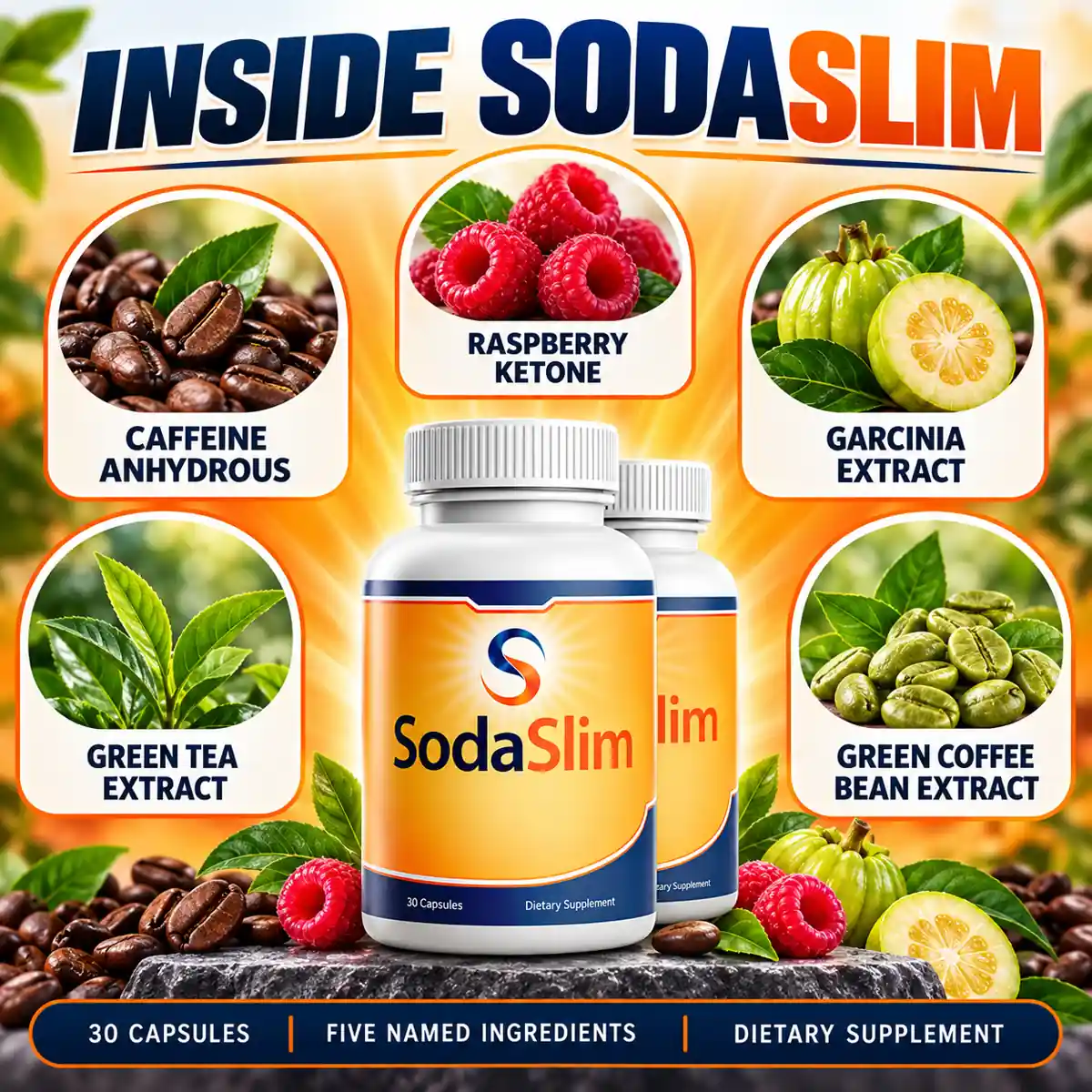
Two sources name the contents of this capsule and they agree with each other. The vendor's INSIDE SODASLIM graphic shows five ingredients in circles around the bottles, and the order desk's product sheet lists the same five in the same sequence.
That agreement is worth noting because it is not universal in this category. Several products this desk handles print one list on the sales page and a different one on the panel, and reconciling them is a job the buyer should never have been given.
- Caffeine Anhydrous
- Green Coffee Bean Extract — Coffea arabica, unroasted seed
- Raspberry Ketone — 4-(4-hydroxyphenyl)butan-2-one
- Garcinia Extract — Garcinia cambogia, fruit rind
- Green Tea Extract — Camellia sinensis, leaf
Below, each of the five gets an entry: what it is, what was tested, at what amount, and what came back.
Five SodaSlim entries, each with the trial that set its dose
Caffeine Anhydrous
dried, concentrated caffeine50–200 mg in trialsCaffeine anhydrous is caffeine with the water taken out, which is what makes it practical in a capsule. Chemically it is the same molecule as the caffeine in coffee; the difference is that a capsule delivers a fixed amount and a mug does not.
This is the one ingredient on the bottle with a human effect that has been shown more than once. In the 1989 thermogenesis study, volunteers given 100 mg raised their metabolic rate for the following two and a half hours, and repeated doses through the day raised total daily energy expenditure in both lean and post-obese groups. Astrup and Toubro traced the same effect across doses and recorded the heart-rate and blood-pressure changes that come with it.
A 2017 randomised trial added a mechanism: catechins and caffeine together activated brown fat and raised cold-induced thermogenesis. That is the pairing this bottle carries, which is the most defensible thing about the formula's design.
What the effect is not is large. The thermogenic response to a single dose is measured in tens of kilocalories, and it fades as tolerance builds in regular consumers. It is a nudge, repeated daily.
Green Coffee Bean Extract
Coffea arabica, unroasted seed180–400 mg in trialsRoasting destroys chlorogenic acid, so green coffee extract is made from beans that were never roasted. The extract carries caffeine as well, which matters for the total this capsule delivers.
A 2023 systematic review pooled twelve randomised trials of chlorogenic acid from green coffee and found a small average reduction in body weight, graded at low certainty. An earlier meta-analysis reached a similar conclusion and was blunt about the quality of the underlying studies.
Two individual trials are worth naming. An eight-week trial in people with metabolic syndrome measured anthropometric indices, glycaemic control, blood pressure and appetite together. A 2021 study in healthy overweight adults reported a shift in the ratio of lean mass to fat mass.
The trial everyone quotes is not on that list, and the reason is on the blog: the crossover study the journal withdrew.
Raspberry Ketone
4-(4-hydroxyphenyl)butan-2-oneno human trial existsRaspberry ketone is the compound that gives raspberries their smell. In food it is a flavouring. In supplements it is sold on the strength of a 2005 paper in which it raised fat breakdown in rodent cells and limited weight gain in mice fed a high-fat diet, and of later mouse work on hypothalamic inflammation.
No randomised trial of raspberry ketone by itself in people has been published. The closest thing is an eight-week trial of a multi-ingredient product in which it is one component among several, which cannot tell you what the ketone contributed.
A 2025 analysis of what raspberry ketone supplements actually contain adds a second reason for caution: the compound is expensive to extract from fruit and most commercial material is synthetic, which is legal and ordinary but worth knowing.
This desk carries no claim that rests on this ingredient, and says so on every page where it comes up.
Garcinia Extract
Garcinia cambogia, fruit rind1,500 mg HCA in the JAMA trialThe active in garcinia rind is hydroxycitric acid. In a test tube it inhibits ATP citrate lyase, an enzyme in the pathway that turns carbohydrate into fat, and that single fact is the whole basis of the ingredient's reputation.
The randomised trial published in JAMA in 1998 put that idea to the most direct test it has had: 135 overweight adults, 1,500 mg of hydroxycitric acid a day for twelve weeks, against placebo, with everyone on the same diet. Fat mass did not differ between the groups.
A 2011 meta-analysis of the trials that followed found a small difference in weight and warned that the effect was of questionable clinical relevance given the quality of the studies. The appetite study looked specifically at whether hydroxycitric acid changes hunger, fullness or how much people eat, and found it did not.
A safety review and a case series of acute liver injury are the other half of the picture. The events are rare; they are also the reason this ingredient has a safety section of its own.
Green Tea Extract
Camellia sinensis, leaf270–1,200 mg catechins in trialsGreen tea extract concentrates the catechins in tea leaves, chiefly epigallocatechin gallate, and usually carries some caffeine with them. It is the most-studied ingredient on this bottle after caffeine itself.
A 2009 meta-analysis found catechin and caffeine mixtures produced a small reduction in weight and helped hold it. The Cochrane review that followed pooled fourteen trials and concluded the average change was small and not clinically important, with wide variation between studies.
A 2024 review asked a narrower question, whether catechins add anything to exercise training, which is the setting closest to how most people would use this capsule.
The dose range across those trials runs from 270 mg to 1,200 mg of catechins a day, which is a spread of more than four to one. Where this bottle sits inside that range is the question the section below is about.
Honest label analysis: why every SodaSlim middle cell says the same thing
Here is what five pieces of artwork show and what they do not. The two-bottle cutout and the three-bottle group both show the front face. The four listing scenes show the same front face from different angles. The vendor's ingredient graphic names the five actives in circles. Between them, no Supplement Facts panel appears anywhere.
That means the middle column of the table below can only ever say one thing, and it would be dishonest to fill it with an estimate.
What follows from that is practical rather than rhetorical.
Caffeine is the row where the number changes the decision. Fifty milligrams is a cup of tea. Two hundred is a large filter coffee. The Health Canada review puts the usual adult ceiling at 400 mg a day from every source combined, so a reader who drinks three coffees needs to know which end of that range this capsule sits at before adding it.
Green tea extract is the row where the number changes the risk. The United States Pharmacopeia review found that rare liver events cluster around concentrated extracts at higher catechin loads, particularly taken without food. A label that named its catechin content would settle that in one line.
Garcinia is the row where the number decides whether the trial applies. The JAMA trial used 1,500 mg of hydroxycitric acid a day and found nothing. If this capsule carries a tenth of that, the trial's negative result is not even the right comparison.
Ring +1 (302) 200-3480, quote lot SOD-26/SE-1477, and ask for two figures: the milligrams of caffeine anhydrous per capsule, and the total catechin content of the green tea extract. A seller with a panel can answer in one call.
What a stronger SodaSlim label would look like
It is easy to criticise a label and harder to say what would have satisfied the criticism. Four lines would do it, and none of them would cost the seller anything a competitor could use.
- A serving size line and a servings-per-container line. One capsule, thirty servings. Two seconds of typesetting.
- A milligram figure for caffeine anhydrous. This is the only row a buyer has to budget for against their own day.
- A standardisation figure for the two extracts: the catechin percentage of the green tea and the chlorogenic acid percentage of the green coffee. Extracts vary by a factor of five without one.
- An other-ingredients line naming the capsule shell. It decides whether the product suits a vegetarian diet, and the vendor's badge set contains a vegetarian roundel that the bottle itself does not carry.
None of that is unusual. It is what the better labels in this category already print, and it is the difference between a product a reader can assess and a product a reader has to trust.
What is not in SodaSlim
Five actives is a short list, and short lists are easier to reason about than long ones. A few absences are worth naming because readers coming from other products in this category will look for them.
| Not in this formula | Where it usually appears | Why its absence matters |
|---|---|---|
| Glucomannan or another soluble fibre | Fullness-first products taken with water before meals | Fibre has the better evidence for satiety. This capsule has no bulking mechanism at all |
| Chromium picolinate | Blood-sugar-framed metabolism stacks | Common, cheap and weakly supported. Its absence costs nothing |
| L-carnitine | Fat-transport framed products | Oral carnitine is poorly absorbed. Its absence is a point in the formula's favour |
| Yohimbine or synephrine | Aggressive thermogenic stacks | Both raise the cardiovascular load sharply. This bottle carries neither, which makes it a milder product than its marketing suggests |
A formula is defined as much by what is left out as by what is in.
Read together, the list above describes a moderate stimulant product. The sales page describes something far more dramatic. The bottle is the more accurate of the two.
Who publishes this SodaSlim website?
- Dulloo AG, Geissler CA, Horton T, et al. Normal caffeine consumption: influence on thermogenesis and daily energy expenditure in lean and postobese human volunteers. Am J Clin Nutr. 1989;49(1):44-50. PMID 2912010. https://pubmed.ncbi.nlm.nih.gov/2912010/
- Astrup A, Toubro S. Thermogenic, metabolic, and cardiovascular responses to ephedrine and caffeine in man. Int J Obes Relat Metab Disord. 1993;17 Suppl 1:S41-3. PMID 8384179. https://pubmed.ncbi.nlm.nih.gov/8384179/
- Yoneshiro T, Matsushita M, Hibi M, et al. Tea catechin and caffeine activate brown adipose tissue and increase cold-induced thermogenic capacity in humans. Am J Clin Nutr. 2017;105(4):873-881. PMID 28275131. https://pubmed.ncbi.nlm.nih.gov/28275131/
- Nawrot P, Jordan S, Eastwood J, et al. Effects of caffeine on human health. Food Addit Contam. 2003;20(1):1-30. PMID 12519715. https://pubmed.ncbi.nlm.nih.gov/12519715/
- Kanchanasurakit S, Saokaew S, Phisalprapa P, et al. Chlorogenic acid in green bean coffee on body weight: a systematic review and meta-analysis of randomized controlled trials. Syst Rev. 2023;12(1):163. PMID 37710316. https://pubmed.ncbi.nlm.nih.gov/37710316/
- Onakpoya I, Terry R, Ernst E. The use of green coffee extract as a weight loss supplement: a systematic review and meta-analysis of randomised clinical trials. Gastroenterol Res Pract. 2011;2011. PMID 20871849. https://pubmed.ncbi.nlm.nih.gov/20871849/
- Roshan H, Nikpayam O, Sedaghat M, et al. Effects of green coffee extract supplementation on anthropometric indices, glycaemic control, blood pressure, lipid profile, insulin resistance and appetite in patients with the metabolic syndrome. Br J Nutr. 2018;119(3):250-258. PMID 29307310. https://pubmed.ncbi.nlm.nih.gov/29307310/
- Sudeep HV, Shyam Prasad K. Supplementation of green coffee bean extract in healthy overweight subjects increases lean mass/fat mass ratio: A randomized, double-blind clinical study. SAGE Open Med. 2021;9:20503121211002590. PMID 33796302. https://pubmed.ncbi.nlm.nih.gov/33796302/
- Morimoto C, Satoh Y, Hara M, et al. Anti-obese action of raspberry ketone. Life Sci. 2005;77(2):194-204. PMID 15862604. https://pubmed.ncbi.nlm.nih.gov/15862604/
- Yao Z, Zhu Z, Chen X. Ameliorative Effect of Raspberry Ketone on Hypothalamic Inflammation in High Fat Diet-Induced Obese Mice. J Nutr Sci Vitaminol (Tokyo). 2024;70(6):496-502. PMID 39756970. https://pubmed.ncbi.nlm.nih.gov/39756970/
- Lopez HL, Ziegenfuss TN, Hofheins JE, et al. Eight weeks of supplementation with a multi-ingredient weight loss product enhances body composition, reduces hip and waist girth, and increases energy levels in overweight men and women. J Int Soc Sports Nutr. 2013;10(1):22. PMID 23601452. https://pubmed.ncbi.nlm.nih.gov/23601452/
- Luque-Jurado I, Yesares M, Soria AC. Evaluation of quality and authenticity of raspberry ketone supplements by a multianalytical approach. J Chromatogr A. 2025;1757:466131. PMID 40513409. https://pubmed.ncbi.nlm.nih.gov/40513409/
- Heymsfield SB, Allison DB, Vasselli JR, et al. Garcinia cambogia (hydroxycitric acid) as a potential antiobesity agent: a randomized controlled trial. JAMA. 1998;280(18):1596-600. PMID 9820262. https://pubmed.ncbi.nlm.nih.gov/9820262/
- Onakpoya I, Hung SK, Perry R, et al. The Use of Garcinia Extract (Hydroxycitric Acid) as a Weight loss Supplement: A Systematic Review and Meta-Analysis of Randomised Clinical Trials. J Obes. 2011;2011:509038. PMID 21197150. https://pubmed.ncbi.nlm.nih.gov/21197150/
- Mattes RD, Bormann L. Effects of (-)-hydroxycitric acid on appetitive variables. Physiol Behav. 2000;71(1-2):87-94. PMID 11134690. https://pubmed.ncbi.nlm.nih.gov/11134690/
- Marquez F, Babio N, Bullo M, et al. Evaluation of the safety and efficacy of hydroxycitric acid or Garcinia cambogia extracts in humans. Crit Rev Food Sci Nutr. 2012;52(7):585-94. PMID 22530711. https://pubmed.ncbi.nlm.nih.gov/22530711/
- Crescioli G, Lombardi N, Bettiol A, et al. Acute liver injury following Garcinia cambogia weight-loss supplementation: case series and literature review. Intern Emerg Med. 2018;13(6):857-872. PMID 29802521. https://pubmed.ncbi.nlm.nih.gov/29802521/
- Jurgens TM, Whelan AM, Killian L, et al. Green tea for weight loss and weight maintenance in overweight or obese adults. Cochrane Database Syst Rev. 2012;12(12):CD008650. PMID 23235664. https://pubmed.ncbi.nlm.nih.gov/23235664/
- Hursel R, Viechtbauer W, Westerterp-Plantenga MS. The effects of green tea on weight loss and weight maintenance: a meta-analysis. Int J Obes (Lond). 2009;33(9):956-61. PMID 19597519. https://pubmed.ncbi.nlm.nih.gov/19597519/
- Gholami F, Antonio J, Iranpour M, et al. Does green tea catechin enhance weight-loss effect of exercise training in overweight and obese individuals? a systematic review and meta-analysis of randomized trials. J Int Soc Sports Nutr. 2024;21(1):2411029. PMID 39350601. https://pubmed.ncbi.nlm.nih.gov/39350601/
- Oketch-Rabah HA, Roe AL, Rider CV, et al. United States Pharmacopeia (USP) comprehensive review of the hepatotoxicity of green tea extracts. Toxicol Rep. 2020;7:386-402. PMID 32140423. https://pubmed.ncbi.nlm.nih.gov/32140423/
Order SodaSlim on the official website
Five named actives, one capsule each morning, and sixty days to decide whether the routine is one you keep.
Two bottles $158 · six bottles $294 · 60-day money-back guarantee
Order SodaSlim On The Official WebsiteOne capsule a day · 30 per bottle · lot SOD-26/SE-1477